Why Manchester Was the Right Place for Innov8rs
Better questions, unexpected connections and why innovation rarely happens in isolation
By Naomi Timperley
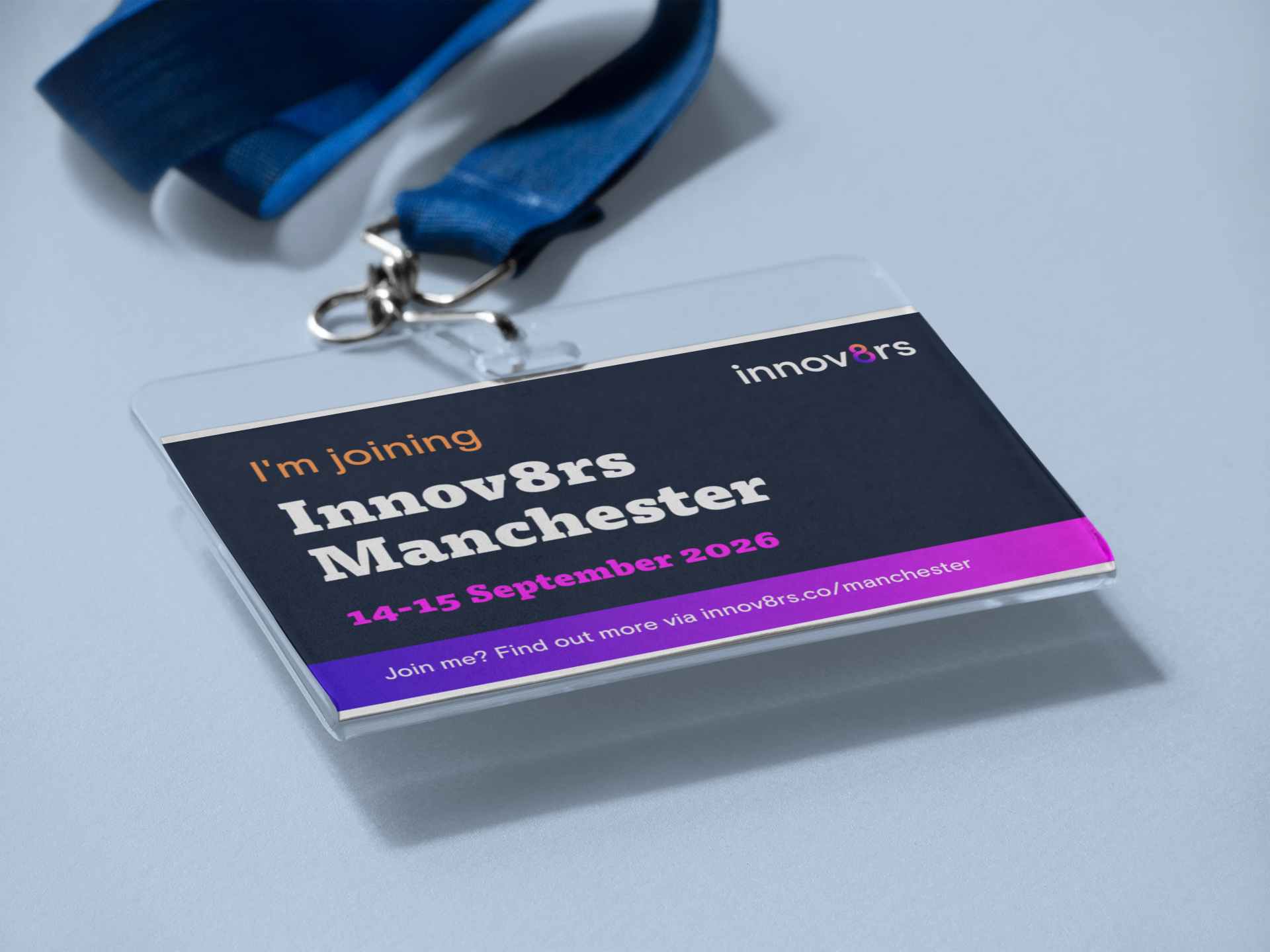
Last week, around 250 corporate innovators from different organisations, industries and countries came to Manchester for two days of conversations about innovation.
I was fortunate enough to play several roles across Innov8rs Manchester, speaking, hosting and moderating, facilitating a Challenge Call, and running our Better Questions Lab with James Akrigg and Fiaz Sadiq.
And a week later, I keep coming back to one thought.
Manchester wasn't simply the location for this conference. It was part of the story.
A city built on reinvention
I opened the conference by talking about Manchester and why I thought it was such an appropriate place to bring together people whose job, in one form or another, is to help organisations reinvent themselves.
Manchester's story is familiar: the Industrial Revolution, cotton, computing, music, football, media, advanced materials, digital and technology.
But the thing that interests me most isn't any single chapter.
It is our ability to keep writing the next one.
Manchester has repeatedly had to ask what it wants to become next. Today's city-region has significant strengths across digital, advanced materials, health innovation, media and creative industries, advanced manufacturing and AI. But that reinvention wasn't the product of one perfect innovation strategy.
It came from generations of people experimenting, building things, connecting ideas, taking risks, failing, trying again and collaborating across boundaries.
That feels particularly relevant now.
The people attending Innov8rs are trying to create change inside organisations that weren't necessarily designed to change quickly.
They are being asked to experiment while others want certainty. To move quickly while navigating governance. And increasingly, to demonstrate the commercial value of innovation before they have necessarily had the opportunity to discover it.
That's difficult work.
And sometimes it's lonely work.
Which is why bringing people doing that work together matters.
Innov8rs deliberately creates that environment. The Manchester conference brought together 250+ corporate innovators for more than 25 sessions, with a strong emphasis on peer learning, practical application and turning innovation ambition into measurable outcomes.
Perhaps we need fewer answers and better questions
One of the themes running through my contributions to the conference was something I've become increasingly interested in:
What happens to innovation when answers become abundant?
AI can now generate ideas, analyse information, produce strategies, research markets and suggest solutions at extraordinary speed.
But it can also produce an extremely sophisticated answer to the wrong question.
That was the premise behind the Better Questions Lab that James Akrigg, Fiaz Sadiq and I ran.
We deliberately asked a room full of innovators to do something that can feel surprisingly uncomfortable:
Don't solve the problem. At least, not yet.
Because organisations are very good at moving quickly into solution mode.
There's a problem. Someone spots an opportunity. Technology enters the conversation. Somebody suggests AI. A pilot gets discussed.
And, as we joked during the workshop, somebody has probably already opened PowerPoint.
But what if the thing we're trying to solve is actually a symptom?
What if an assumption has quietly become accepted as fact?
What if the customer doesn't think the problem is the problem?
What if a constraint that shaped the original process no longer exists?
And perhaps most importantly:
What if AI isn't the answer?
The Lab took real organisational challenges through three different lenses, System, Possibility and Value, before introducing another powerful perspective: the outsider.
Participants were encouraged to find somebody whose world was least like their own and let them question the challenge.
The objective wasn't to leave with a cleverer answer.
It was to leave with a better question, a hypothesis and a small experiment, something that could actually be tested back inside the organisation.
One piece of feedback afterwards particularly stayed with me:
“Your session in particular really challenged my thinking, thank you.”
For me, that's the point.
A good innovation session shouldn't simply confirm what you already believe. It should make you look at something differently.
Innovation needs outsiders
There was another aspect of Innov8rs that reinforced this for me.
I was asked to facilitate one of the conference's Challenge Calls, where someone brings a genuine organisational challenge into the room and peers help them explore it.
I received a lovely note afterwards from the Innov8rs Learning Lead:
“Especially the Challenge Call. It is not an easy format to facilitate, and the challenge owners gave us great feedback on it.”
What I enjoyed about the format is that it demonstrates something I've seen repeatedly over the last fifteen years.
Sometimes the most useful person in the room isn't the person who knows the most about your industry.
It's the person who knows enough to ask the question everybody else has stopped asking.
That was also one of the messages I wanted people to take from Manchester.
Innovation doesn't happen in isolation.
It happens because somebody connects two people who would never normally meet.
It happens because somebody asks a question everyone else has stopped asking.
It happens because somebody challenges an assumption that has quietly become accepted as fact.
And that is one of Manchester's great strengths.
Manchester's innovation ecosystem doesn't belong to anyone
I've spent a large part of my career working across Manchester's technology and innovation ecosystem, and one of the things I value most about it is that no single organisation owns it.
Not the universities.
Not the corporates.
Not the founders.
Not investors.
Not government.
At its best, it works because those worlds overlap.
You see researchers talking to founders.
Corporates working with startups.
Universities working with industry.
Investors meeting technologists.
Public-sector organisations connecting with entrepreneurs.
And increasingly you see disciplines colliding that historically might have had very little reason to talk to one another.
That matters because some of the most interesting innovation now happens between traditional sectors and disciplines rather than neatly inside them.
Healthcare can learn from gaming.
Manufacturing can learn from software.
Financial services can learn from behavioural science.
Corporates can learn from startups, and startups have an enormous amount to learn from corporates.
For two days, Innov8rs created another version of exactly that environment in Manchester.
We don't need to have all the answers
There is a pressure that comes with working in innovation.
We're expected to know what's next.
We're expected to understand AI.
We're expected to spot opportunities.
We're expected to walk into rooms and solve problems.
But I'm increasingly convinced that one of the most valuable things an innovation leader can say is:
“I'm not sure that's the problem. Can we ask a better question?”
That was how we ended the Better Questions Lab.
And perhaps that's also what I took away from Innov8rs Manchester.
Not another innovation framework.
Not another prediction about AI.
But a reminder of the importance of creating spaces where people can admit they don't know, challenge what they think they know, learn from people outside their normal world and explore a problem before rushing towards a solution.
It also reminded me why I care so much about bringing events like this to Manchester.
International innovation conferences don't only showcase a city.
They connect its ecosystem to ideas, people and organisations from elsewhere.
They allow visitors to discover what's happening here.
But just as importantly, they expose us to different perspectives.
That's how ecosystems stay alive.
Not by telling themselves how brilliant they are, but by continually allowing new people, ideas and challenges in.
Manchester has been reinventing itself for more than 200 years.
That reinvention isn't finished.
And I can't think of many better places to gather people whose job is to ask:
What needs reinventing next?
Thank you to the Innov8rs team for bringing the conference to Manchester, to everyone who trusted me to host and facilitate conversations, to James Akrigg and Fiaz Sadiq for creating the Better Questions Lab with me, and particularly to everyone who brought their questions, challenges and experiences into the room.
My challenge at the start of the conference was simple:
Don't just look for answers. Look for better questions.
I'm even more convinced of that now.